AI Mental Balance Checklist: A 10-Minute Daily Reset

What “mental balance” looks like day to day
Mental balance isn’t a permanent state of calm—it’s the ability to notice what’s happening internally, respond with a helpful next step, and return to baseline more reliably over time. Day to day, imbalance often shows up as racing thoughts, irritability, low motivation, poor sleep, or feeling overwhelmed by even small decisions.
Balance works more like a skill set than a personality trait: awareness (catching the moment you’re tipping), naming emotions (so they’re less blurry and scary), realistic planning (so your day isn’t built on wishful thinking), and recovery routines (so stress doesn’t pile up unnoticed).
Checklists help because they reduce cognitive load when your brain is already working hard. Instead of re-deciding your coping plan from scratch, a repeatable structure creates consistency and makes progress visible—even when progress is simply “I paused before I spiraled.” AI can fit into this by organizing thoughts quickly, offering gentle coaching-style questions, and summarizing patterns from journaling so you can see what’s been driving stress.
Safe ways to use AI for mental health support
AI can be a useful support tool for reflection and routine-building, but it’s not a diagnostic authority, not therapy, and not an emergency service. The safest approach is to treat it like a structured notebook: helpful for organizing, clarifying, and practicing skills—while keeping real-world support in the loop when needed.
- Choose neutral, nonjudgmental language. If a tool “agrees” with harsh self-talk, reframe and ask for compassionate, factual wording.
- Set boundaries: time-box conversations (5–10 minutes), avoid late-night spirals, and stop if you feel more distressed.
- Protect privacy: avoid identifying details; summarize situations instead of pasting sensitive records.
- Know red flags: persistent hopelessness, thoughts of self-harm, inability to function, or panic that won’t ease.
AI support vs. human support: what each is best for
| Need | AI can help with | A human professional is best for |
|---|---|---|
| Clarifying feelings | Emotion labeling, reflection questions, journaling structure | Therapeutic processing, trauma-informed care |
| Reducing overwhelm | Breaking tasks into steps, prioritization, coping menu ideas | Treatment planning, assessing impairment and risk |
| Skill practice | CBT-style reframes, mindfulness scripts, habit tracking templates | Personalized therapy, accountability, medication management (if needed) |
| Crisis moments | Providing general grounding ideas and resource reminders | Immediate safety planning and urgent intervention |
For trustworthy background information, visit National Institute of Mental Health (NIMH) or WHO’s mental health overview. If you need help finding treatment or urgent support resources, SAMHSA’s Find Help can point you to appropriate services.
How the Mental Balance checklist works (digital download)
The checklist format is built for repeatability: quick check-in → identify stressors → choose a coping action → reflect → plan the next step. That structure matters most on busy days, when your mind wants either to shut down or to overthink. With short prompts (often 3–10 minutes), you get a “good enough” plan you can actually follow.
It’s flexible, too: use it daily, a few times per week, or only during high-stress periods. Many people pair it with a notes app or mood tracker, so they can copy/paste quick summaries and keep everything in one place. Results typically come from consistency over intensity—small actions completed regularly, not a perfect streak.
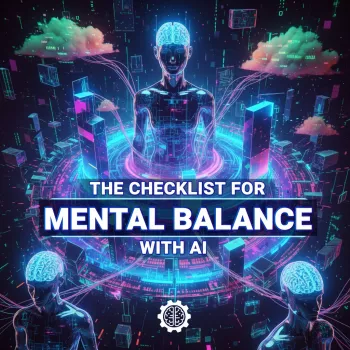
If you want a ready-to-use template, see The Checklist for Mental Balance with AI (digital download). For a deeper, step-by-step framework on using AI safely and effectively, How to Use AI to Support Mental Health (eBook) expands on routines, boundaries, and practical examples.
A practical routine: 10-minute AI-assisted self-care check-in
This routine is designed to be brief enough that you’ll still do it when you’re tired, stressed, or short on time.
- Minute 1–2: Name your current state: energy (low/medium/high), mood, and stress level (0–10). Identify one main trigger.
- Minute 3–5: Ask for three coping options that match your situation (grounding, movement, connection, problem-solving).
- Minute 6–8: Choose one action that is realistic today. Break it into the smallest next step (something you can start in under two minutes).
- Minute 9: Add a compassionate, factual reframe—no forced positivity. Aim for “true and kind.”
- Minute 10: Set a simple follow-up reminder (water, a short walk, text a friend, bedtime cue, or scheduling support).
Over time, this becomes a stability loop: you notice sooner, recover faster, and build confidence that tough moments can shift without needing a complete life overhaul.
Example AI questions to support emotional balance
Personalizing the checklist to your life
When to pause AI and seek extra support
FAQ
Can AI replace therapy for mental health?
AI can support routines, reflection, and coping skill practice, but it can’t diagnose, provide clinical treatment, or respond appropriately to crises. If symptoms are significant, persistent, or getting worse, professional care is the safest next step.
Is it safe to share personal feelings with an AI tool?
It can be safer to share summaries rather than identifying details, and to avoid sensitive records or private information. Check the tool’s privacy practices, and stop using it if it increases rumination, anxiety, or distress.
How often should the checklist be used for best results?
A realistic cadence is daily or about 3–5 times per week with a 5–10 minute time limit. During high-stress periods, using it more frequently can help, but consistency matters more than intensity.





Leave a comment